
Glass and Plate Holder
-
Glass and Plate holder L shaped - small - ChromeRegular price £2.97Unit price / perRegular priceSale price £2.97
-
Glass and Plate holder cylindrical - Chrome MattRegular price £4.97Unit price / perRegular priceSale price £4.97
-
Glass and Plate holder cylindrical - Stainless SteelRegular price £4.97Unit price / perRegular priceSale price £4.97
-
Glass and Plate holder cylindrical - ChromeRegular price £4.97Unit price / perRegular priceSale price £4.97
-
Glass and Plate holder L shaped II - SatinRegular price £6.39Unit price / perRegular priceSale price £6.39
-
Glass and Plate holder L shaped II - Stainless SteelRegular price £6.39Unit price / perRegular priceSale price £6.39
-
Glass and Plate holder L shaped II - ChromeRegular price £6.39Unit price / perRegular priceSale price £6.39
-
Glass and Plate holder L shaped I - Chrome MattRegular price £4.97Unit price / perRegular priceSale price £4.97
-
Glass and Plate Holder Rectangular - SatinRegular price £4.97Unit price / perRegular priceSale price £4.97
-
Glass and Plate Holder Rectangular - Chrome MattRegular price £4.97Unit price / perRegular priceSale price £4.97
-
Glass and Plate Holder Rectangular - Black MattRegular price £4.97Unit price / perRegular priceSale price £4.97
-
Glass and Plate Holder Rectangular - Stainless SteelRegular price £4.97Unit price / perRegular priceSale price £4.97
-
Glass and Plate Holder Rectangular - ChromeRegular price £4.97Unit price / perRegular priceSale price £4.97


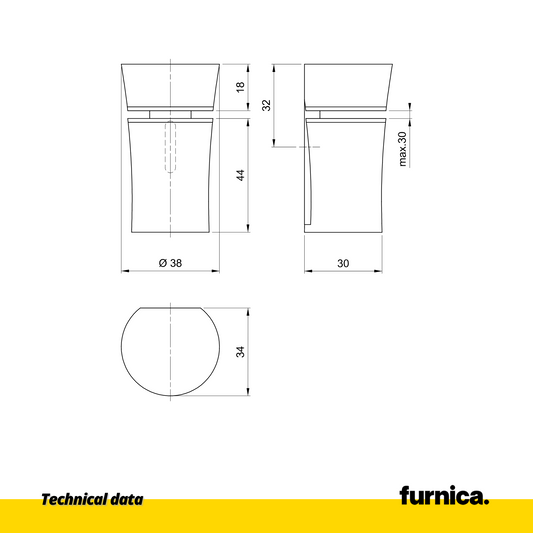


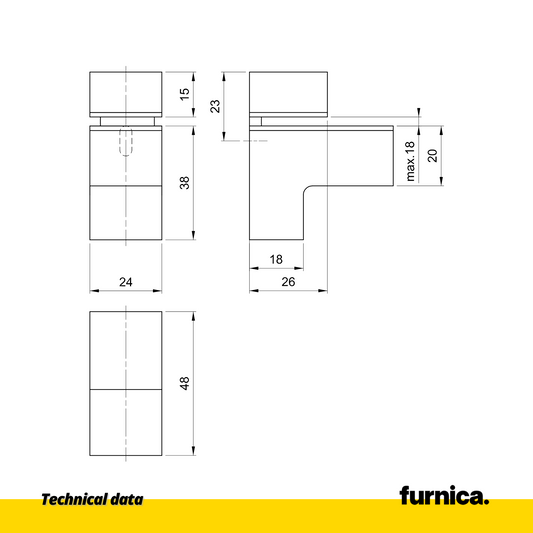


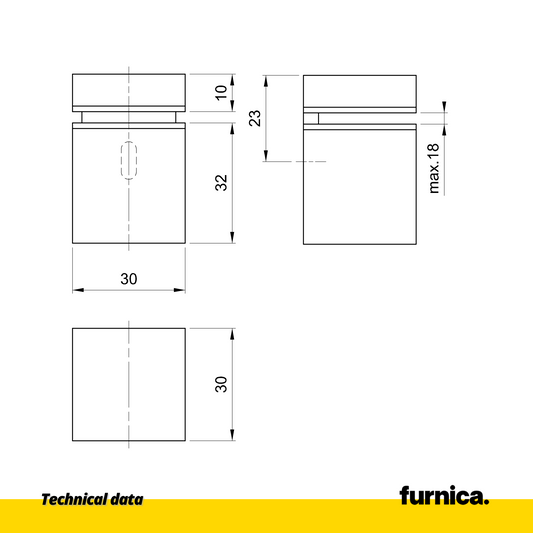
Glass and plate holders are precision-made fittings that hold glass shelves securely, without slipping and without point loads, in cabinets, display cases or directly on the wall. Unlike solid wood or wood-based boards, glass is very hard, brittle and completely inelastic, so supporting it calls for specialised fittings. Direct contact between hard metal and glass inevitably leads to stress cracks or scratches under load or vibration. Properly designed glass supports therefore use elastic cushioning pads, soft plastics, suction cups or defined clamping jaws to spread the load evenly over the bearing surface and reliably stop smooth glass shelves shifting in the carcass.
Design types and how they work
Furniture and wall shelves are planned around two basic design principles: plug-in supports for carcass systems and clamp holders for self-supporting wall mounting. Each system meets different structural requirements and needs precisely matched fixing points.
Plug-in shelf supports for carcass fitting
In furniture making, for example in showcases, living-room display cabinets or bathroom cabinets, shelves usually rest on cylindrical pegs. The dominant size in industrial furniture production is a diameter of 5 mm, matched exactly to the 32 mm line boring. Delicate special constructions occasionally use 3 mm holes instead.
To hold a glass shelf, plug-in shelf supports use different contact interfaces:
- Built-in suction cups: Elastic suction pads act like a shield for the glass, damping vibration and fixing it reliably by suction against accidental shifting. A proven example is the Glass Shelf Support Ø5mm with a Suction Cup, made of nickel-plated steel and silicone.
- Combined plastic pads: Supports such as the Glass Shelf Clamping Support Bracket Ø5mm or the classic Ø5mm version separate the glass from the load-bearing steel peg with precisely fitted plastic or soft components.
- Tube adapter: For special constructions with round profiles, the chrome Glass Shelf Support with Suction Cup allows a stable connection to Ø 25 mm tubes.
Clamp brackets and adjustable Pelican holders
Wall-hung glass shelves without side panels use Pelican clamp brackets. These consist of a robust wall-mounting base and a movable clamping jaw, adjusted by hand with an underside clamping screw. They accept panel thicknesses in typical clamping ranges of 4 mm to 10 mm or 4 mm to 15 mm. The clamping creates a static cantilever that absorbs bending and leverage forces gently through soft interlayers.
Material properties, alloys and finishes
The long-term load capacity of a glass shelf support depends on the core material and a resistant surface finish. Pegs are preferably made of solid steel to withstand high shear forces, while geometrically complex clamp bodies are often cast from zinc-aluminium alloy (ZnAl / Zamak), combining high dimensional stability with excellent accuracy.
The surface finishes protect the support core from moisture and blend seamlessly into modern interiors:
- Chrome (high-gloss): Electroplated chrome brackets have a very smooth, hard and moisture-resistant protective layer. They are ideal for bathroom furniture and sanitary areas. Available in several sizes, such as the Pelican Shelf Support Bracket 35x40mm - Chrome, the medium 45x55mm, the 55x75mm and the large 70x105mm versions.
- Satin (matt / brushed nickel): This finely textured surface minimises light reflections and resists fingerprints. Matt versions are available in identical dimensions, such as the Pelican Shelf Support Bracket 35x40mm - Satin, the compact 45x55mm, the generously sized 55x75mm and the large-format 70x105mm versions.
- Nickel-plated steel: Offers solid basic corrosion protection for sheltered interiors in the carcass.
Project planning and structural criteria for glass shelves
Unlike wood-based materials, glass cannot absorb elastic deformation from uneven mounting points. When designing glass shelving, lever arms, glass thicknesses and spans must be matched precisely.
Carcass shelves on 4-point support need all four drill holes exactly level. If one support sits lower or higher, this creates 3-point support that twists the pane diagonally – spot overloading under extra load is the result. A suction-cup support also works as an effective anti-tilt safeguard when shelves are relieved on one side by uneven removal of items.
On wall-mounted glass shelves, the torque at the wall fixing rises sharply with shelf depth. Narrow shelves with little overhang need only small Pelican brackets of 35x40 mm or 45x55 mm. Deeper glass shelves need bracket sizes of 55x75 mm or 70x105 mm to take up the leverage forces over a large area and clamp the glass securely.
Fitting and handling guidance
For a professional installation of glass and plate holders, observe the following steps:
- Check hole accuracy: Carcass holes for 5 mm pegs must be drilled square with a clean wood drill bit. Hole depth must at least match the peg shank length so the support sits fully flush against the carcass.
- Set the wall anchors: With Pelican brackets, the base is fitted using wall plugs suited to the masonry. Before tightening, align both brackets exactly with a spirit level.
- Prepare the glass contact: Make sure the soft rubber inserts or silicone pads sit cleanly on the clamping jaws. The glass must never touch the cast zinc or steel body directly.
- Clamping by hand: Slide the glass shelf horizontally into the clamp opening until it stops. Tighten the underside clamping screw hand-tight with a suitable manual screwdriver only. Never use a cordless drill, to rule out stress peaks in the glass.
Care and maintenance
Glass and plate holders are easy to care for. Cleaning needs only soft microfibre cloths with mild, pH-neutral soap solution or household glass cleaner. Never use abrasive cleaners, strong acids or scouring sponges, as they can damage electroplated chrome and satin coatings and make the rubber inserts brittle. In commercial or damp environments, check regularly that the clamping screws are tight.
Complementary fittings and related categories
For fully equipping modern furniture projects, the furnica.co.uk range offers matching hardware components:
- Shelf supports & brackets – Comprehensive choice of heavy-duty brackets, shelf supports and concealed support systems for wood and composites.
- Wood screws and furniture screws – Matching fixing screws with precise drives for carcass fixing and wall mounting.
- Furniture connectors – Sturdy cam and carcass connectors for precise cabinet assembly on the 32 mm grid.
- Cup hinges / cabinet hinges – Reliable hinge systems for hinged doors, standard and wide-angle.
- Cup hinges / cabinet hinges with damping – High-quality hinges with integrated Soft-Close for gentle, silent closing.
- Cover caps – Discreet covers for drill holes and connecting fittings for a clean finish inside the cabinet.
- Adjustable plinth feet – Height-adjustable cabinet legs for precisely levelling units on uneven floors.
- Furniture locks – High-quality locking systems for securing glass-door and display cabinets.
Frequently asked questions
What drill size do plug-in shelf supports in glass cabinets need?
Standard carcasses built to the 32 mm system need a 5 mm drill diameter and a minimum hole depth of 8 mm. For particularly delicate display cabinets or specialist furniture, pegs for 3 mm holes are occasionally available from trade suppliers. Drill exactly square so the support sits flush against the carcass.
How is a glass shelf prevented from slipping out?
Soft intermediate elements prevent slipping. Plug-in shelf supports use built-in silicone suction cups or soft plastic caps that form a grippy connection. On self-supporting wall shelves, Pelican clamp brackets hold the glass panel mechanically with padded clamping jaws, gripping the pane firmly and damping vibration.
Which Pelican bracket suits which shelf depth?
Compact sizes such as 35x40 mm or 45x55 mm suit shallow glass shelves up to about 150 mm deep. For deeper shelves of 200 mm to 300 mm, choose bracket sizes of 55x75 mm or 70x105 mm. The longer bearing surface reduces leverage forces and protects the glass from localised bending overload.
Are Pelican glass brackets also suitable for wooden and chipboard shelves?
Yes, Pelican clamp holders can hold wood-based, solid-wood or plastic shelves as well as glass. The only requirement is that the panel thickness falls within the bracket's clamping range (for example 4 mm to 15 mm) and the clamping screw is tightened evenly.
Can a cordless drill be used to fit clamp brackets?
No, the clamping screw on glass and plate holders must only be tightened with a manual screwdriver. A cordless drill creates uncontrolled torque spikes that can overload the glass locally and cause instant cracks or microscopic damage.